Aug 25, 2026

Acne may eventually clear, but the aftermath often remains in the form of unsightly scars. Many people who once suffered from acne are left with uneven texture, shallow depressions, and visible scarring long after the active breakouts have stopped.
These residual changes can undoubtedly affect confidence and make the skin look older or less refined than it feels. Fortunately, non-ablative fractional laser treatments offer a targeted way to address these concerns. Frax laser skin resurfacing is designed to stimulate skin renewal and collagen production, which can help improve both acne scars and overall skin texture.
This article focuses on how Frax laser works for acne scars and skin texture, what types of scarring respond best, what recovery looks like, and how results develop over time. Whether you are researching Frax laser for acne scars in Westlake Village or simply exploring laser skin resurfacing options, understanding the process can help you set realistic expectations. Here’s what you need to know:
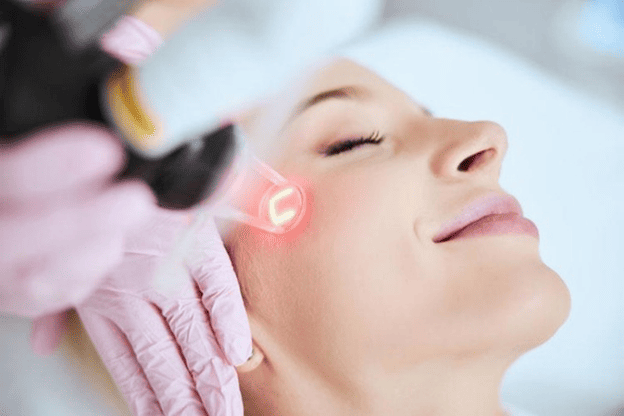
Frax laser is a form of fractional laser resurfacing that we perform at Remedy Skin + Body with advanced technology using Nordlys Ellipse. Instead of removing or heating the full surface of the skin in one continuous pass, it delivers energy in a pattern of microscopic treatment zones. These tiny columns of controlled heat create microscopic treatment zones within the skin while leaving surrounding tissue untreated. The untreated areas act as reservoirs of healthy cells that support faster healing.
The controlled thermal injury triggers the skin’s natural repair response. Fibroblasts become more active, and the body begins producing new collagen and elastin. Over the following weeks and months, this new collagen remodels the treated tissue. The result is gradual tightening, smoothing, and refinement of the skin’s architecture. Because only a fraction of the skin is treated in each session, recovery is typically more manageable than with fully ablative lasers, while still delivering meaningful remodeling. This mechanism is what makes Frax laser skin resurfacing effective for both discrete scars and broader textural concerns.
Atrophic acne scars that appear as depressions or indentations form when inflammation damages collagen during the healing of breakouts. Once the scar tissue has formed, the skin lacks the normal volume and smooth contour of surrounding areas. Frax laser addresses this by stimulating fresh collagen production within and around the scar.
As collagen remodels within and around the treated area, depressed scars may gradually appear shallower and their edges softer. The contrast between the scar and normal skin decreases, making the marks less noticeable. Improvement is progressive rather than instantaneous. Patients typically see gradual blending rather than complete disappearance of every scar.
Results depend on several factors: the type and depth of the scarring, the patient’s age and skin quality, and how consistently collagen remodeling occurs between sessions. Frax laser for acne scar treatment works best as a remodeling tool. It improves the appearance of scars rather than erasing them entirely. Deep or long-standing scars usually require a series of treatments and realistic goals focused on softening rather than perfection.
Also Read: Benefits of Laser Skin Therapy and Microneedling for Acne Scars
Not every acne scar responds the same way. Rolling scars with a wave-like or undulating appearance and areas of shallow textural irregularity often improve noticeably with fractional laser treatment. The broad remodeling effect helps even out the surface.
Some boxcar scars, particularly those that are shallower, can also respond well. Deeper boxcar scars may show improvement but often need more aggressive or combined approaches. Ice-pick scars, which are narrow and deep, tend to be the most stubborn. These frequently require additional techniques such as chemical reconstruction or punch procedures in combination with laser work, because fractional energy alone may not reach the full depth effectively.
It is also important to distinguish true structural scars from post-acne discoloration or lingering redness. Pigment changes and erythema are different problems and may respond better to other modalities. A proper evaluation identifies whether the primary concern is texture and depression (which may respond to fractional resurfacing) or color, so treatment can be matched accurately.
This is why two patients with “acne scars” may receive very different treatment recommendations. Someone with broad rolling scars may be a strong Frax candidate, while deep ice-pick scars may need a combination approach rather than additional laser sessions alone.
Beyond individual scars, Frax laser for skin texture delivers broader benefits. Many patients notice that the entire treated area becomes smoother and more even. The appearance of enlarged pores may also improve as overall skin texture becomes smoother and softer.
Because the laser stimulates collagen across a field rather than only at scar sites, the surrounding skin improves in quality as well. This creates a more uniform appearance. When the background texture is refined, residual scars blend more successfully. The cumulative effect is skin that looks healthier, feels smoother, and reflects light more evenly, with benefits that extend beyond acne scar improvement alone.
Acne scars rarely resolve with a single session. Collagen remodeling is a biological process that unfolds over time, and each treatment builds on the last. Most patients undergo a series of Frax laser treatments spaced several weeks apart. The exact number depends on scar type and depth, baseline skin condition, treatment intensity, and individual goals.
Someone with mild rolling scars and good skin elasticity may see satisfying improvement after fewer sessions. Deeper or more widespread scarring typically requires more treatments. Results continue to develop between appointments as new collagen matures. Consistency and patience are essential; rushing the process or expecting dramatic change after one visit usually leads to disappointment.
Early changes appear as the skin heals and surface cells renew, often within the first couple of weeks. Redness fades, and the treated area may feel smoother. The more significant improvements in scar depth and texture occur later, as collagen production ramps up over the subsequent one to three months and sometimes longer.
Acne-scar improvement with Frax laser is progressive. Each session contributes incremental remodeling, and the final outcome is best judged several months after the last treatment. Patients who understand this timeline tend to be more satisfied because they recognize that meaningful change is cumulative rather than immediate.
Recovery varies with treatment intensity and individual response. Common short-term effects include redness, mild swelling, sensitivity, and a temporary rough or sandpaper-like texture as microscopic treatment zones heal. These sensations typically resolve over several days to a week or more, depending on the settings used.
Sun protection is critical during the healing phase and beyond. Newly treated skin is more vulnerable to pigment changes, so diligent sunscreen use and sun avoidance support optimal results. A gentle skincare routine focused on hydration and barrier support helps minimize discomfort. Most patients return to normal activities relatively quickly, though more aggressive settings may require a few extra days of downtime.
Frax laser is particularly well suited for patients whose primary concerns are acne-related textural changes and certain depressed scars. It is less ideal as a standalone solution for very deep ice-pick scars or for active inflammatory acne. Skin type, scar morphology, and overall skin health all influence candidacy.
A thorough evaluation is the best way to determine whether Frax laser treatment alone will meet expectations or whether a customized combination approach would be more effective. Some patients achieve their goals with fractional laser resurfacing by itself; others benefit from pairing it with complementary procedures for deeper or more complex scarring.
Also Read: Microneedling vs Laser Resurfacing: Which Treatment Is Right for You?
At Remedy Skin + Body in Westlake Village, treatment planning begins with a careful assessment of each patient’s unique scar pattern, skin characteristics, and goals. There is no single laser solution that fits every case of acne scarring. Frax laser resurfacing may be an excellent option for many patients with acne scars, but the decision is highly individualized.
If you are dealing with residual acne scars or uneven skin texture and want to explore whether fractional laser resurfacing can help, schedule a consultation at Remedy Skin + Body today.