
If you have started to notice horizontal lines settling across your forehead, or a pair of vertical creases forming between your brows, you are looking at some of the most common early signs of facial aging. At Remedy Skin + Body in Westlake Village, forehead lines and wrinkles are treated by a physician-led team under Medical Director Talia Emery, M.D., a certified Botox and Juvederm trainer who has been recognized by Allergan as one of the top Botox and Juvederm providers and injectors in the country. The right plan depends on whether your lines appear only with movement or have begun to linger at rest, and the practice walks you through those options in plain language before anything is scheduled. This page explains what causes forehead lines, how Remedy evaluates them, which treatments may be recommended, and why patients across the Conejo Valley choose this team for natural-looking results.
Schedule Your Westlake Village Consultation | Call (805) 497-9400
Complimentary consultations are available. No pressure, just a plan built around your face.
★ Remedy Skin + Body has been recognized as a Top 50 provider of Botox Cosmetic nationwide and a top provider nationwide for more than ten years, with Dr. Talia Emery serving on Allergan’s Facial Aesthetics Advisory Board.

Forehead lines are the horizontal lines that appear across the forehead when you raise your eyebrows or express surprise. They belong to a broader group of upper-face lines that also includes glabellar lines, the vertical creases between the eyebrows often called frown lines, along with crow’s feet at the outer corners of the eyes and bunny lines along the nose. Most of these begin as dynamic wrinkles, meaning they are created by the repeated movement of the muscles underneath the skin.
Over time, two things change. The frontalis muscle across the forehead keeps contracting every time you lift your brows, and the skin itself loses some of its natural support. Hyaluronic acid, which helps skin hold hydration, elasticity, and volume, decreases with age, and collagen and fat gradually diminish as well. Sun exposure, smoking, and stress can speed this along. As that support fades, lines that once appeared only with movement can start to linger even when the face is at rest.
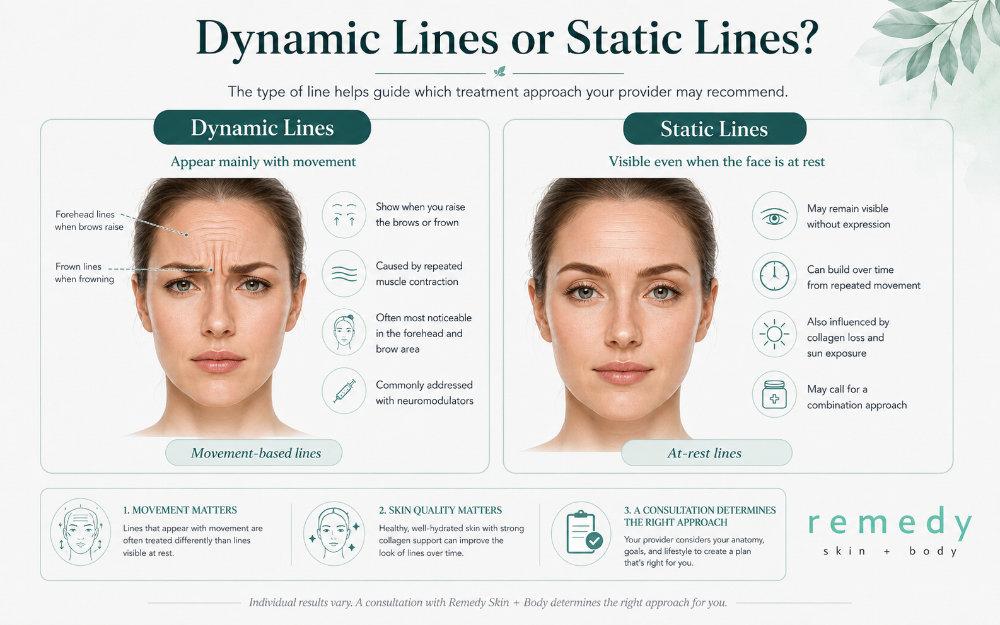
The single most useful question during a forehead consultation is whether your lines are dynamic or static, because the answer shapes the entire treatment plan. Dynamic lines show up only when the muscles move, and they tend to respond well to neuromodulators such as Botox that relax the underlying muscle. Static lines remain visible when your face is completely at rest, because years of folding have etched them into the skin and collagen loss has thinned the support beneath them.
This distinction is why a careful evaluation matters more than a standard menu. A forehead with purely dynamic lines may be well served by Botox alone, while deeper static lines may call for a combined approach that also supports the skin itself. At Remedy, the provider assesses how your forehead moves, where the lines sit at rest, and how your brows relate to the muscles around them before recommending anything.
“I have been getting botox and fillers for a really long time. I have to say that Dr. Emery is the best. She knows to only use enough to keep my face looking natural. Love the staff they are very fun and make me feel comfortable.”
Adults who are bothered by forehead lines or frown lines and want a smoother, more rested look are often good candidates for treatment, and the best way to know is a consultation. Many clients come in during their thirties and forties when dynamic lines first become noticeable, while others come later hoping to soften creases that have already set in. Candidacy is less about age and more about the type of lines, your skin health, your medical history, and what you want your face to look like afterward.
Neuromodulators such as Botox are not appropriate for everyone. People who are pregnant or breastfeeding, who have certain neuromuscular conditions, or who have a known sensitivity to the product are generally advised against treatment, which is one reason a medical evaluation comes first. If your goals point toward something other than an injectable, the provider will say so. The practice is built around recommending only what is right for you, rather than fitting every face to the same solution.
Depending on the depth of your lines and whether they are dynamic or static, a customized plan may draw on one or more of the treatments below. Each links to a dedicated page with more detail, and the provider explains which combination fits your face during the consultation.
Botox is the treatment most often associated with forehead lines. It works by blocking the nerve signals that tell the muscle to contract, which temporarily relaxes the targeted muscle and softens the lines it creates. Remedy identifies Botox as a treatment for forehead lines, frown lines, crow’s feet, and bunny lines, and the team also works with other reputable neuromodulators. Because every face is different, the provider evaluates you and selects the most appropriate neuromodulator and plan rather than applying a fixed formula.
Fillers restore volume and fullness where age-related loss has occurred, and Remedy offers the JUVEDERM Portfolio, the Restylane Collection, and the RHA Collection, all hyaluronic-acid-based. In the upper face, filler is commonly used to restore volume in the temples, the areas on the sides of the forehead that can hollow with age and create a tired appearance. Restoring that volume may help balance facial proportions and soften the transition between the forehead and upper face, and it can complement Botox when both muscle movement and volume loss are present.
For lines tied to skin texture and sun damage rather than muscle movement alone, Remedy uses Frax fractionated laser skin resurfacing on the Nordlys Ellipse platform. Frax targets fine lines, wrinkles, and uneven texture by stimulating collagen production and new skin-cell growth, which may support smoother, more refined skin over time. Temporary redness or mild swelling may occur and often improves within a few days, depending on treatment settings and your skin response.
Many patients benefit from more than one approach. Dynamic lines may be addressed with a neuromodulator while surrounding volume loss is supported with filler and overall skin quality is improved with laser resurfacing. The point of the consultation is to sort out which of these your forehead actually needs, in what order, so the result looks like a rested version of you rather than an overdone one.
★ Every treatment plan at Remedy is guided by a simple principle the practice states plainly: it only recommends procedures and products that have proven to be safe and effective, so if it offers something, it believes in it.
Who performs an injection matters as much as which product is used, especially on the forehead, where the goal is to soften lines while preserving natural expression where possible. Care at Remedy is led by a Medical Director whose training and national recognition are specific to exactly this kind of work.
Dr. Talia Emery is Remedy’s Medical Director and Director of Staff Education, and she actively sees and treats patients while overseeing all aspects of client care. She earned a Bachelor of Science in biology from UCLA and her M.D. from Temple University’s School of Medicine, then completed her residency with UCLA at Kaiser Permanente Woodland Hills, where she served as Chief Resident and later Attending Physician as a board-certified family physician. Her focus for years has been aesthetic medicine, and her reputation in it is national in scope.
Dr. Emery is a certified speaker and trainer for Botox and Juvederm, which means she is engaged to train other physicians and their staff across the country in the same category of injectable techniques used in upper-face treatment. She has been recognized by Allergan as one of the top Botox and Juvederm providers and injectors in the country, serves on Allergan’s Facial Aesthetics Advisory Board, and is part of the National Speakers Bureau for Latisse. Alongside her, the practice includes Andrea Horita, NP, a nurse practitioner and medical education specialist, registered nurses Sara Evans and J.T. Thai, licensed esthetician Sharin Harn, and medical assistant Mackenzie Greenfield, so clients can be matched with the right provider for each part of a plan.
“Friendly and professional. From the moment you arrive you know you are in great hands. The front staff are top notch. Dr. Emery is quite skilled and does not try to over do the treatments. She is gentle and explains what she is doing so you are not in the dark. I was impressed every step of the way. I would highly recommend Remedy Skin + Body for any of your facial needs.”
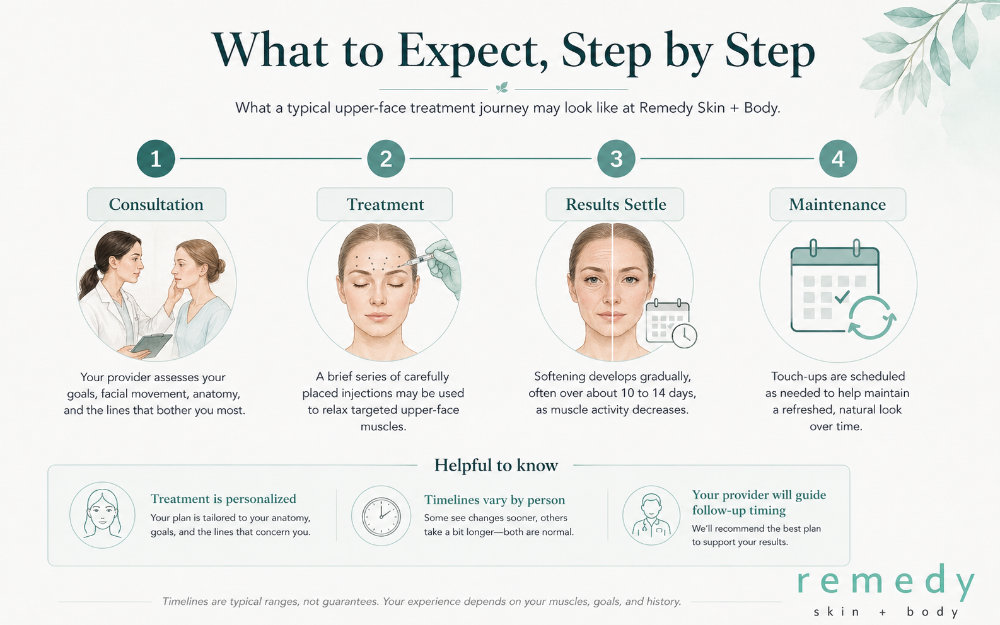
A neuromodulator visit for forehead lines is often brief and can fit into a normal day for many clients. After the consultation, treatment typically involves a short series of small injections into the muscles that create your lines. There is little to no downtime for most people, and many clients schedule it around work or errands nearby on Thousand Oaks Boulevard.
Results are not instant. Softening typically begins within a few days and settles over roughly ten to fourteen days as the muscle relaxes, and the effect generally lasts a few months before movement gradually returns.
Because the results are temporary, most clients plan periodic maintenance to keep the forehead looking rested. Individual timelines and longevity vary with your muscle strength, your goals, and how your body responds, all of which the provider reviews with you.
Injectors are not hard to find in the Conejo Valley. What tends to set this decision apart for Westlake Village patients is the combination of physician-level expertise, a conservative philosophy aimed at natural results, and a practice culture built around the individual. The points below summarize how Remedy positions its care for Westlake Village patients.
★ Clients repeatedly point to the same thing in their reviews: a skilled injector who does not overdo the treatments and explains each step, so patients are never in the dark about what is happening on their forehead.
There is no single best treatment for everyone, because the right choice depends on whether your lines are dynamic or static. Dynamic forehead lines often respond well to Botox, while deeper static lines may call for a combined plan that also supports the skin, such as laser resurfacing. Your provider at Remedy evaluates your forehead and recommends the approach suited to your lines and goals.
Deep, static forehead wrinkles can often be softened, though they may not disappear completely with a single treatment. Because these lines involve both muscle movement and changes in the skin, a layered plan that pairs a neuromodulator with skin-focused treatments like Frax laser resurfacing may help more than one approach alone. A consultation is the best way to set realistic expectations for your case.
Botox has a long track record for treating dynamic forehead lines when it is administered by a qualified medical provider who understands facial anatomy. At Remedy, treatment is physician-led and every plan begins with a medical evaluation of your history and suitability. As with any medical treatment, it carries some risks, which your provider reviews with you beforehand.
The main cause is repeated movement of the forehead muscle over time, which folds the skin again and again until lines form. Age-related loss of collagen, hyaluronic acid, and elasticity makes the skin less able to bounce back, and factors like sun exposure, smoking, and stress can accelerate the process. This is why forehead lines often start as dynamic lines and gradually become more visible at rest.
Microneedling stimulates collagen and can help improve overall skin texture, which may soften the appearance of some fine lines over a series of sessions. It works on the skin itself rather than the muscle movement that drives dynamic forehead lines, so it is often considered as part of a broader plan rather than a standalone fix. Your provider can advise whether it fits your goals during a consultation.
They address different causes, so better depends on your lines. Botox relaxes the muscle movement behind dynamic forehead lines, while microneedling and similar skin treatments work on texture and collagen. For many patients the two are complementary rather than competing, and the provider helps you decide what your forehead actually needs.
Microneedling improvements develop gradually as collagen remodels, and because natural aging continues, results are not permanent and periodic maintenance sessions may be recommended. Consistent skin care and sun protection help preserve the improvement. Your provider can outline a realistic maintenance rhythm for your skin.
Botox and fillers do different jobs. Botox relaxes the muscle movement that creates dynamic forehead lines, while fillers may restore volume in selected areas where age-related loss has occurred, such as the temples of the upper face. When both muscle movement and volume loss are present, the two can complement each other, which is something the provider assesses at your visit.
Remedy’s forehead-related filler work focuses on restoring volume in the temples and upper face rather than injecting directly into forehead lines themselves, and the practice offers the JUVEDERM, Restylane, and RHA hyaluronic acid collections. The most appropriate product depends on the area and your goals, which the provider selects during a personalized evaluation. Dynamic forehead lines themselves are more commonly addressed with a neuromodulator.
Forehead wrinkles are driven mainly by muscle movement and the natural, age-related decline of collagen, hyaluronic acid, and skin elasticity rather than by a single nutritional deficiency. Lifestyle factors such as sun exposure, smoking, and stress can make them appear sooner. If you have concerns about your skin health, a provider can discuss what is realistic and when a treatment may help.
For most patients, forehead results settle over about ten to fourteen days and then last a few months before muscle movement gradually returns. How long yours lasts depends on your muscle strength, your metabolism, and how consistently you maintain treatment. Many Westlake Village clients plan periodic touch-ups to keep the forehead looking rested year-round.
It does not have to when treatment is planned conservatively by an experienced injector. The goal at Remedy is to soften excessive movement while preserving your natural expression, which is why the team emphasizes conservative dosing and careful placement. A frozen look usually comes from overtreatment or poor placement, not from the treatment itself.
Give yourself at least two weeks. Softening begins within a few days, but the full effect settles over roughly ten to fourteen days, so booking ahead of a wedding, reunion, or social event near the Promenade at Westlake gives the treatment time to settle before the event. Your provider can help time it around your calendar.
Yes. Years of sun exposure, whether around Westlake Lake, on local trails, or simply driving the 101, can accelerate collagen loss and make forehead lines appear sooner and look deeper. Daily sun protection is part of keeping results looking their best, and it matters even more after laser resurfacing. Your provider can fold sun care into your overall plan.
Neuromodulator treatment for forehead lines involves little to no downtime for most people, and many clients return to their day right afterward. Frax laser resurfacing may involve a few days of temporary redness or mild swelling that often improves within a few days, depending on the treatment settings and your skin response. Your provider explains the expected recovery for whichever treatment fits your plan so you can schedule accordingly.
“I have been going to Remedy for over 6 years now. I love the entire staff, everyone is so quick, so easy, so wonderful at what they do. I’ve never had a bad treatment or experience here. Best botox and filler experts. They have great deals and coupons for treatments as well. Highly recommend.”
Patients travel to the Thousand Oaks Boulevard center for forehead and upper-face treatment from across Westlake Village and the surrounding Conejo Valley. Common areas we welcome patients from include:
The guides below come from the Remedy Skin + Body team to help you understand your options for the upper face and choose between related treatments. They are for general education and do not replace an in-person evaluation with a provider.
The best forehead results start with a provider who listens first, explains your options clearly, and treats your face with a light, deliberate hand so it still looks like you. At Remedy Skin + Body, Dr. Emery and the team take the time to understand what is bothering you, walk through which treatments could realistically help and which they would not recommend, and build a plan aimed at a rested, natural result rather than a frozen one. When you are ready to talk it through, reach out and the team can help you take the next step.
Book Your Forehead Consultation Today
Schedule Your Westlake Village Consultation | Call (805) 497-9400
Remedy Skin + Body 3723 E Thousand Oaks Blvd, Westlake Village, CA 91362
Hours:
